Most business owners are not fire safety specialists. They still carry the responsibility. Proportionate fire risk assessments for small premises, written to be understood and acted on, with Kevin or Jon on every visit.
For years, a business with fewer than five employees did not have to write its fire risk assessment down. Many owners still believe that is the case.
It is not. Since 1 October 2023 every business must record its assessment in full, however small.
A small premises does not need a long report. It needs an accurate one that tells you what to do first.

If you are the employer or you control the premises, you are the responsible person under the Fire Safety Order 2005. You must assess the risk, record the findings and your fire safety arrangements, keep escape routes and equipment maintained, tell staff what to do and keep the assessment under review. The 2023 changes also require you to record who carried out the assessment.
For a very small, simple premises the law allows it, and the government publishes a guide for small non-domestic premises to help. It becomes harder where you share a building, have people sleeping on site, store flammable materials, have a complicated layout or welcome the public in numbers. If you appoint someone, you remain responsible for choosing a person who is competent, so ask about qualifications and ask for a sample report.
Your landlord is usually responsible for shared entrances, stairs and alarm systems, and you for the space you occupy. You need your own assessment for your unit, and the law requires you and the landlord to co-operate. We note where your responsibility stops so that you are not paying to fix somebody else’s problem.
An assessment done informally years ago, with no record that meets the current law.
Stock, bins or a locked gate on the only alternative way out.
Daisy-chained adaptors and heaters under desks and counters.
No weekly test, no service record, or no alarm where one is needed.
Nobody sure who calls the fire service or where to assemble.
Cardboard and cleaning products stored around the electrical cupboard.
No annual service, or the wrong type for the risk.
None on the escape route from windowless rooms or basements.
No contact with the landlord or neighbours about shared routes and alarms.
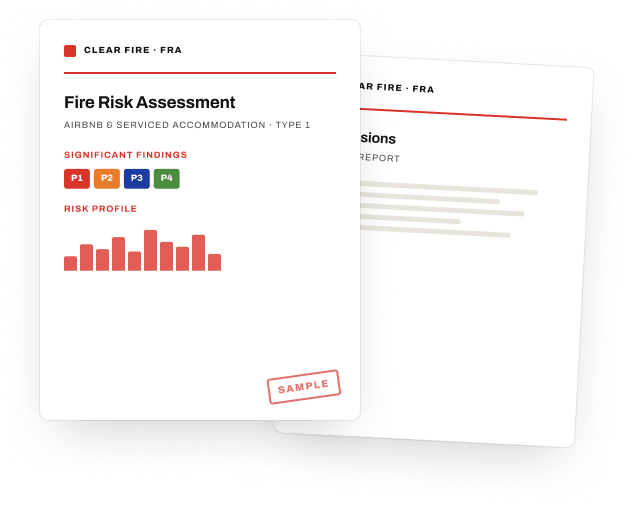
You receive a signed PDF with a plain English summary, a photograph for each finding and actions in four priority bands.
It meets the requirement to record your assessment in full, and it tells you what to do this week, this quarter and this year.
Thank you for carrying out an assessment of my workplace. The advice was useful and fully implemented. Would recommend you to others.


Tell us about your premises and we confirm scope and availability within one working hour. Kevin or Jon on site, signed report within 24 hours of invoice payment.
Not sure whether you need us or can do it yourself? Kevin and Jon will give you a straight answer before you book.
Yes. The Fire Safety Order applies to virtually every business premises in England and Wales, including those with only one or two staff.
Yes. Since 1 October 2023 the assessment must be recorded in full regardless of the number of employees.
For a very small, simple premises, yes, using government guidance. If the premises are shared, complex or involve sleeping, a competent assessor is the safer choice.
The Order does not apply to a private home. It can apply if part of the home is used as business premises that staff or the public visit.
The landlord covers shared areas. You are responsible for the space you control, and you need your own recorded assessment.
Everyone should know the escape routes, how to raise the alarm and where to assemble, with instruction when they start and refreshers after that. Larger teams need named fire marshals.
Most small businesses review annually, and whenever the layout, staffing, stock or activities change significantly.
Fire officers can issue notices requiring improvements or restricting use of the premises, and serious breaches can be prosecuted. Insurers may also ask for the assessment after a claim.
Tell us about your site. We'll respond within one working hour during business hours.