A building can be fully let and fully operational while still carrying fire safety risks that nobody has reviewed. Assessments for multi-let and landlord-controlled commercial property, carried out by Kevin or Jon in person.
In a multi-let commercial building the tenants look after their own units. Everything in between, such as entrances, stairs, corridors, plant rooms, risers, loading bays and shared alarm systems, usually stays with the landlord.
Those shared areas are where responsibility is least clear and where fire spreads between occupiers.
This page is for owners and asset managers. If you occupy an office yourself, see our offices page.

Under the Fire Safety Order 2005 duties fall on whoever has control of premises, to the extent of that control. For a commercial landlord that normally means the common parts, the structure, shared fire safety systems and any vacant units. The lease decides the detail, which is why we ask to see how the demise and repairing obligations are drawn.
The Order requires responsible persons who share a building to co-operate and co-ordinate. Since 1 October 2023 they must also identify themselves to each other and record their assessments in full. In practice this means knowing that each tenant has an assessment, that a tenant’s fit-out has not compromised the shared alarm or escape routes, and that someone tests the systems everyone depends on.
Common escape routes and final exits. Fire doors and compartment lines between units. Risers, plant rooms and roof voids. The landlord’s fire alarm, emergency lighting and smoke control, with their service records. Vacant units, which carry arson and maintenance risks of their own. External storage, bin stores and loading areas. Findings are compared with the relevant government guidance for the uses in the building.
New partitions and ceilings that cut off detection or breach a compartment wall.
Nobody sure who tests, services or responds to the landlord's system.
Left unsecured, with services live and combustible waste inside.
Used as storage, with unsealed penetrations between floors.
Walls between units that stop at the suspended ceiling.
Pallets, stock and waste from one tenant blocking the exit for all.
Bins and pallets stacked against the building, inviting arson.
The landlord unable to show that occupiers have met their own duty.
Zone plans and fire strategy drawings that no longer match the building.
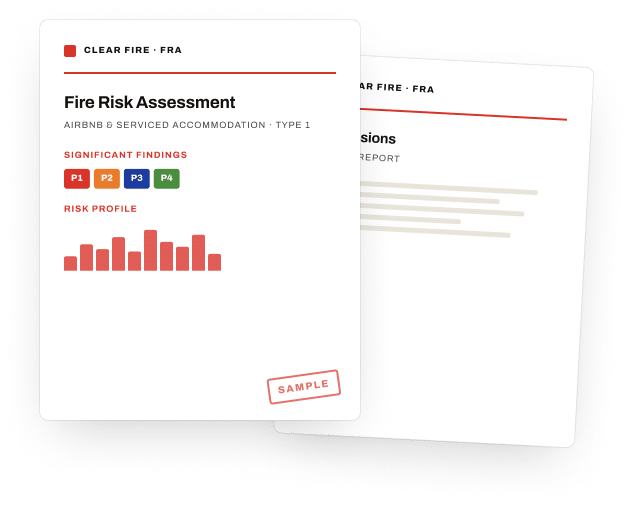
Your report arrives as a signed PDF with a management summary, a photograph for each finding and actions in four priority bands.
It records where landlord and tenant responsibilities meet, so that each finding can be passed to the party who must act on it.
Sheaf FRA Ltd provided a thorough and professional fire risk assessment for our office building. Knowledgeable and detailed, with clear recommendations to improve safety.


Tell us about the building and we confirm scope and availability within one working hour. Kevin or Jon on site, signed report within 24 hours of invoice payment.
Not sure where your responsibility ends and your tenant's begins? Kevin and Jon are happy to talk it through before you book.
Usually both. Tenants are responsible for the space they control, and the landlord for common parts, structure and shared systems. The lease sets the boundary.
It depends on the lease. On a full repairing lease the tenant usually holds the duty. If you keep control of any part, plant or system, you hold duties for that.
An empty unit is still premises under the landlord’s control. It needs assessing, securing and checking, particularly for arson risk and isolated services.
Yes. The duty to co-operate makes this reasonable, and insurers increasingly expect landlords to hold evidence that occupiers have assessed their own units.
It can. New partitions, ceilings and services often affect detection, compartmentation and escape routes, so a review after fit-out is sensible.
The guide that matches each use, for example offices and shops, factories and warehouses, or places of assembly. The assessment draws on each as needed.
Most commercial landlords review annually, and after a change of tenant, a fit-out, building work or any fire.
Reports name the assessor and their qualifications and set out evidence, reasoning and priorities, which is what insurers and enforcing authorities look for.
Tell us about your site. We'll respond within one working hour during business hours.