One portfolio. Multiple buildings. Different risks and responsibilities. Consistent fire risk assessments for block and estate managers, with Kevin or Jon on every visit.
A managing agent is nearly always the person asked to explain fire safety, whether to a freeholder, a residents’ management company, an insurer, a leaseholder at an AGM or a fire safety inspecting officer.
That only works if the assessments across the portfolio are consistent, current and written so that a non-specialist can follow them.
With ClearFire, the person your property manager speaks to is the person who walked the building.

Under the Fire Safety Order 2005 the responsible person is usually the freeholder or management company. Article 5 also places duties on anyone who has control of the premises to any extent, or a contractual obligation for maintenance or safety. An agent whose agreement covers those matters will normally fall within that. Each management agreement should say clearly who commissions the assessment, who approves spending and who signs off completed actions.
Section 156 of the Building Safety Act 2022 added duties that land on an agent’s desk. Assessments and fire safety arrangements must be recorded in full. Responsible persons in the same building must identify themselves to each other and co-operate. Residents must be given relevant fire safety information. An outgoing responsible person must pass fire safety information to the incoming one, which matters every time a block changes agent.
Under the Fire Safety (England) Regulations 2022 all blocks must give residents fire safety and fire door information. Buildings over 11 metres need quarterly communal door checks and annual flat entrance door checks. Buildings of at least 18 metres or seven storeys need a secure information box, plans for the fire service, external wall information, monthly equipment checks and wayfinding signage. Our reports record which tier applies and whether evidence of compliance was available on the day. Where works are recoverable through the service charge, section 20 consultation may be needed, so we flag those items early and describe each defect precisely enough for comparable quotations.
Each block assessed by a different firm in a different format, with no way to compare.
Reports taken over from a previous agent that are out of date or silent on external walls and doors.
Quarterly and annual checks required by law, with nothing written down.
No evidence that fire safety and fire door information has been issued.
Findings left open because nobody agreed whether landlord, agent or leaseholder should act.
New cabling and pipework run through risers and compartment walls without fire-stopping.
Residents' belongings, mobility scooters and e-bikes in escape routes.
Service contracts lapsed when the block changed hands.
Missing, incomplete or out of date in high-rise buildings.
Every building is reported in the same format, following BS 9792:2025, with a management summary that can go straight to a client or board.
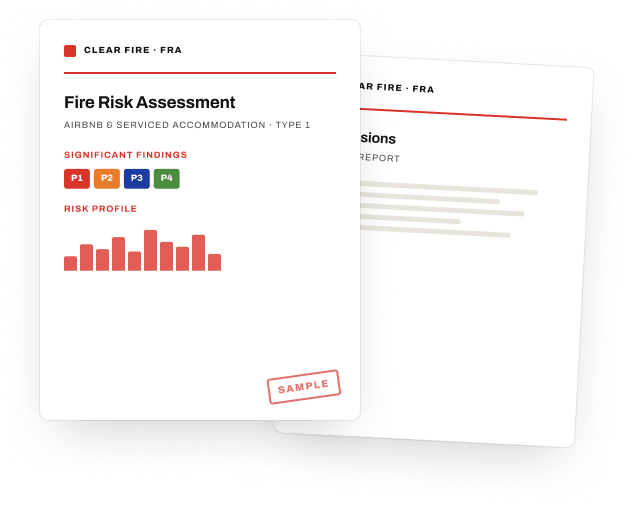
Each report recommends the assessment type with reasons, records flat entrance and communal doors in a way that supports your door checking records, and sets actions in four priority bands.
We have used Jon on several occasions and introduced him to our clients, who have all been very happy with the service. Fair and quick responses. Highly recommend.


We reply within one working hour, can usually visit the same week and issue the signed report within 24 hours of invoice payment.
Taking on a new block or facing a deadline? Kevin and Jon are happy to talk it through before you instruct.
Usually not alone. The freeholder or management company is normally the responsible person, and the agent has duties to the extent of their control or contractual obligations. In practice enforcement letters often go to both.
Yes. We agree a programme with you in advance, and the same two assessors cover every building using one report format.
Every assessment of a building with two or more homes considers the external walls. Where a detailed appraisal is needed, that is a separate exercise under PAS 9980 carried out by a specialist, and we say so clearly.
A Type 1 assessment does not require entry to flats, although we inspect a sample of flat entrance doors. If a Type 3 assessment is justified, we agree in advance which flats will be sampled.
If it is out of date, generic or silent on doors and external walls, a new assessment gives you a reliable baseline before you commit the client’s money to works.
In most leases the cost of assessing the common parts is recoverable through the service charge. Check the lease or take advice where the wording is unclear.
The law sets no interval. We recommend a review date for each building based on its height, age, construction and residents, and any material change should trigger an earlier review.
We reply within one working hour, can usually visit the same week and issue the signed report within 24 hours of invoice payment.
Tell us about your site. We'll respond within one working hour during business hours.