Independent office fire risk assessments carried out by Kevin or Jon, never a junior, never a subcontractor. Clear findings, prioritised actions and evidence ready for responsible persons, insurers and property stakeholders.
Offices rarely stand still. Teams grow, layouts change, meeting rooms become workspaces and new equipment arrives long before the documents catch up.
An assessment completed years ago may no longer reflect how the building is occupied, managed or used today.
ClearFire assesses the office you have now, including multi-tenant arrangements, hybrid working, shared facilities, server rooms, storage and means of escape.

Under the Fire Safety Order 2005 the employer is the responsible person for the workplace they control. They must assess the risk, keep escape routes and fire safety equipment maintained, train staff and plan for an emergency. Since 1 October 2023 the assessment must be recorded in full however small the business.
In a multi-let office the landlord or managing agent is normally responsible for the common parts and shared systems, and each tenant for their own demise. The Order requires them to co-operate and co-ordinate, and since 2023 to tell each other who they are. We record where each party’s responsibility starts and stops, because that is where most gaps appear.
Offices are assessed using PAS 79-1:2020 and compared with the government guide for offices and shops. Particular attention goes to people who need help to escape, because personal emergency evacuation plans are often out of date once working patterns change.
Most office assessments identify several of these, and most are quick to put right once they are properly documented.
Often between open-plan floors and the protected stair, where they undermine the whole escape strategy.
Extension leads, chargers and unmanaged cabling create ignition sources that are easy to overlook.
Poor housekeeping, blocked ventilation or missing detection in rooms the business depends on.
Small appliances and combustible storage pushing risk beyond what the layout was designed for.
Deliveries, archive boxes and supplies finding their way into corridors, lobbies and stair cores.
Failed fittings, missing test records and gaps in coverage after a layout change.
Hybrid working leaving fewer trained marshals in the building than the plan assumes.
Personal emergency evacuation plans missing, out of date or not matched to current staff.
Landlord and tenant each assuming the other has dealt with shared systems or routes.
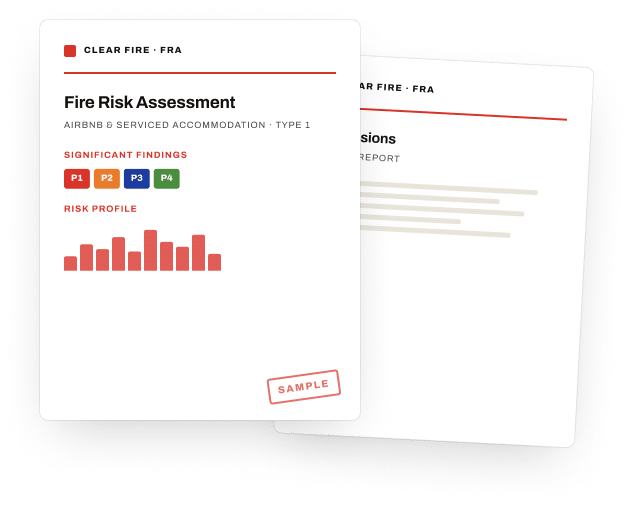
Your report arrives as a signed PDF with a management summary, a photograph for each finding and an action plan built around risk and priority.
Recommendations are grouped into four bands, so you can see what needs attention now, what should be planned and what can be monitored.
Sheaf FRA Ltd provided a thorough and professional fire risk assessment for our office building. Knowledgeable and detailed, with clear recommendations to improve safety.


Tell us about the building and we confirm scope and availability within one working hour. Kevin or Jon on site, signed report within 24 hours of invoice payment.
Jon and Kevin are happy to give you a straight answer before you book. No sales pitch, just plain advice.
Yes. The Fire Safety Order applies to virtually all workplaces in England and Wales, and the assessment must be recorded in full whatever the number of staff.
Usually the employer for the space they occupy, and the landlord or managing agent for shared areas. In multi-let buildings there are often several responsible persons who must co-operate.
Yes. The landlord’s assessment covers the common parts. It does not assess your layout, your staff or your equipment, which remain your responsibility.
Fire hazards, people at risk, escape routes, fire doors, alarm and emergency lighting, signage, staff training, drills, maintenance records and how fire safety is managed day to day.
It can. Fewer people on site may mean too few fire marshals on some days, and evacuation plans for individuals may not reflect who is actually in the building.
There is no fixed interval. Most offices review annually and after any refit, change of layout, new tenant or significant change in headcount.
Enforcement action, unlimited fines and prosecution are all possible, and insurers commonly ask for the assessment after a loss.
Only where it genuinely covers both the common parts and the tenant’s own space, and both parties have agreed who acts on which findings. In most buildings separate assessments are clearer.
Tell us about your site. We'll respond within one working hour during business hours.