Fire risk assessments for
small businesses.

Straightforward, proportionate fire risk assessments for small employers, meeting your legal duty without unnecessary cost or complexity. Kevin or Jon on-site, plain-English report, no upselling.

What we find

The law applies to you too, but it should be proportionate.

If you employ anyone, the Fire Safety Order applies to your premises, whether you are a six-person studio, a workshop, a salon or a small office. The duty is the same as for a large building; what changes is that the assessment should be proportionate to a simple, lower-risk premises.

The risk for small businesses is the opposite of over-specification: it is being sold a thick, generic report you don't need, or having no written assessment at all because "we're too small to bother". Both fail you when an insurer or fire officer asks.

Clear Fire gives small businesses a clear, honest, right-sized assessment carried out by Kevin or Jon, meeting your legal duty without selling you precautions a building your size doesn't need.

What we find in small premises.

Drawn from Kevin and Jon's combined assessment experience. In smaller premises the findings are usually simple and inexpensive, but they are the ones that fail an inspection.

No written assessment

Premises employing five or more people with no recorded fire risk assessment, the most common small-business breach, and the first thing an inspector asks for.

Single escape route

Reliance on one exit or a route that passes the highest-risk area, with no assessment of whether it is adequate for the occupancy.

Detection & alarm adequacy

No alarm, or detection that would not be heard throughout the premises, especially in workshops or noisy environments.

Electrical & portable appliances

Overloaded sockets, daisy-chained extension leads and appliances with no PAT or maintenance record.

Extinguisher provision

Wrong type or location for the risk, or no annual service, and no one trained to use them.

Housekeeping & storage

Combustible stock or waste building up near ignition sources or across the escape route.

Staff awareness

No simple evacuation plan and no record that staff have been shown what to do, required even in the smallest workplace.

Fire-action information

No fire-action notice and no clear assembly point for a small team to account for everyone.

Risk-rated findings. Costed action plan. Insurer-ready.

Your assessment arrives as a signed PDF with a one-page management summary at the front, photographic evidence stitched to every finding, and a separately downloadable evidence appendix.

Findings are prioritised against the PAS 79-1 likelihood-and-consequence matrix into four bands, each with an indicative remediation window.

P1

Immediate

Within 14 days · risk to life
P2

Short-term

Within 3 months · serious
P3

Medium-term

Within 12 months · moderate
P4

Improvement

Best-practice · advisory
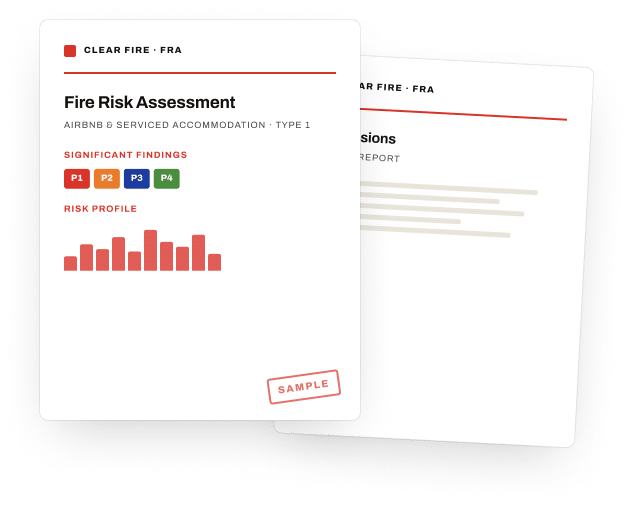
Clear Fire · FRA
Conclusions
Sample Report
Clear Fire · FRA
Fire Risk Assessment
Small Business · Type 1
Significant findings
P1P2P3P4
Risk profile
SAMPLE

Kevin was superb in responding quickly when asked to step in and replace an inadequate fire risk assessment delivered by another firm.

Charlie Parkes
Verified Google review
★★★★★ · Bonnar FRA
Case Study

How we run multi-site fire compliance as one programme.

For clients with several buildings, we run every site to one report format, one assessor relationship and one annual review cycle, so your responsible person and insurer see a consistent evidence trail across the whole portfolio.

Insurer asking, or just want it sorted? We keep it simple.

Tell us about your premises and we'll confirm a proportionate scope and a fixed price within one working hour. Kevin or Jon on-site, signed report within 24 hours of invoice paid.

Request a same-week visit

Everything you need to know about fire risk assessments for small businesses.

Still have questions?

Kevin and Jon are happy to give you a straight answer before you book, no sales pitch, just plain advice.

Speak to an owner →
Yes. The Regulatory Reform (Fire Safety) Order 2005 requires every workplace to have a suitable and sufficient fire risk assessment, there is no exemption for being small. If you employ five or more people (or hold a licence) it must be recorded in writing. Even below that threshold you must still carry out and act on the assessment; recording it is simply best practice.
For a small, simple, low-risk premises it is legally permissible to do it yourself, and the government publishes guidance to help. In practice most small-business owners lack the time and the methodology to produce something that will satisfy an insurer or a fire officer, which is why a competent third party is usually the safer and quicker route.
It means the assessment genuinely reflects your premises and the people in it, the real hazards, the people at risk, and the precautions needed, rather than a generic template with your name on the front. The depth should be proportionate: a simple premises needs a simple but genuine assessment, not a 60-page document.
We price by the size and complexity of the premises, not by a fixed package, and give you a quote in writing before any work begins. For a small, single-unit business it is one of the most cost-effective compliance steps you can take, and far cheaper than the consequences of not having one.
There is no formal size cut-off in the law, the assessment simply has to be proportionate to the risk. As a guide, a single-storey or single-unit workplace with a modest number of staff, no sleeping risk and no significant special hazards is the kind of premises where a streamlined assessment is appropriate.
A missing or inadequate assessment is the most common breach found on fire-service visits, and small businesses are not exempt from enforcement. Outcomes range from an improvement notice to prosecution and unlimited fines, and most business insurance is conditional on meeting your fire-safety duties.
At least annually, and whenever something changes, a move, a refit, more staff, new equipment or a new process. For a stable small premises an annual review is usually enough.

We assess every type of building.

Our fire risk assessment programme covers 11 other property types, each with its own dedicated page, assessor knowledge and report format.

Offices & Commercial Premises

Type 1–2 assessments for single and multi-tenanted offices. Covers means of escape, compartmentation, alarm systems and responsible person obligations.

View service

Blocks of Flats

Type 1–4 assessments aligned with PAS 9980. Common parts, cladding, external wall systems, compartmentation and fire door registers.

View service

Warehouses & Light Industrial

Storage classifications, racking risk, sprinkler interaction, shift-work occupancy and insurers' specific requirements for industrial premises.

View service

Managing Agents

Multi-site programmes for portfolio managers. Consistent reporting format, shared document portal and annual review schedules across all properties.

View service

Airbnb & Serviced Accommodation

Short-let and serviced apartment assessments for hosts and operators. Platform compliance, guest safety documentation and local authority requirements.

View service

Commercial Properties

Retail units, mixed-use developments and landlord-controlled commercial space. Tenant obligations, common areas and change-of-use requirements.

View service

Retail

Shop and retail unit assessments covering public-facing occupancy, stock storage risk, emergency lighting and staff training evidence.

View service

HMOs

Houses in multiple occupation. Licensing-compliant assessments covering protected routes, interlinked detection, fire doors and local authority requirements.

View service

Landlords

Private landlord obligations under the Fire Safety Order and the Smoke and Carbon Monoxide Alarm Regulations. Residential and mixed-use portfolios.

View service

Pubs & Restaurants

High public footfall, kitchen fire risk, late-night occupancy and licensing implications. Assessments written for hospitality operators and their insurers.

View service

Care Homes

Vulnerable occupancy risk profiles, protected escape routes, staff procedures and CQC-aligned documentation for registered care providers.

View service
URGENT FIRE SAFETY REQUEST

Insurer deadline this week? Enforcement notice landed?