When several households share one property, fire safety responsibilities become more complex. Fire risk assessments for HMOs built around licensing requirements, tenant safety and day-to-day management, carried out by Kevin or Jon in person.
An HMO carries more fire risk than a family home of the same size. More people, more cooking, more electrical load, locked bedroom doors and tenants who may not know each other.
Small issues grow quickly when several tenants rely on the same escape route, the same fire doors and the same alarm.
That is why HMOs attract two sets of fire safety law at once, and why councils look closely at fire precautions before granting or renewing a licence.

The Housing Act 2004 gives the council powers over the whole property through HMO licensing and the housing health and safety rating system. The Fire Safety Order 2005 applies to the common parts, such as hallways, stairs, landings and shared kitchens, and requires a recorded fire risk assessment. The HMO management regulations also require the manager to keep escape routes clear and alarms and equipment working, whether or not the property needs a licence.
In England a licence is mandatory where five or more people forming two or more households live in the property. Councils can also run additional licensing schemes that bring smaller HMOs in. Licensing is handled by the local housing authority, for example Buckinghamshire Council, Milton Keynes City Council, Oxford City Council, Reading Borough Council or Luton Borough Council, and conditions differ between them, so the conditions on your own licence are the starting point.
The benchmark for existing HMOs is the LACORS Housing Fire Safety guidance, used by councils and fire services across England. It sets expected standards by property type, covering the grade of detection under BS 5839-6, protection of the escape route, fire doors, emergency lighting and fire blankets. Our methodology follows BS 9792:2025, and both assessors hold Level 3 fire door inspection qualifications.
These are the findings that regularly appear in HMO fire risk assessments and licensing reviews.
Bedroom doors planed to clear carpet or fitted with locks that damaged the door edge.
Closers removed or disabled by tenants, leaving the escape route unprotected.
Alarms that suited a family let but are the wrong grade or coverage for an HMO.
Hallways and stairs used for bikes, drying racks, deliveries and waste.
Electrical intake and storage with no fire-resisting lining beneath the only staircase.
Front doors that need a key to open from inside.
Cooking positioned on the escape route, with no fire blanket provided.
Alarm and emergency lighting tests that stopped when the last tenant moved in.
Occupants never told what to do if the alarm sounds.
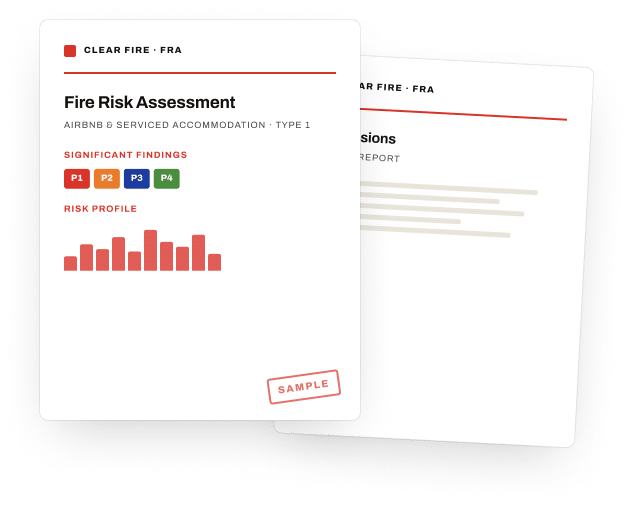
Your assessment arrives as a signed PDF with a management summary and a photograph for each finding, written so it can be handed to a licensing officer, insurer or letting agent without further explanation.
Actions are set out in four priority bands, and most are inexpensive to put right once they are identified clearly.
I highly recommend Kevin Bonnar for fire risk assessments. He is incredibly professional, punctual, and conducted an extremely thorough inspection of our property.


Tell us about the property and we confirm scope and availability within one working hour. Jon or Kevin on site, signed report within 24 hours of invoice payment.
If you are unsure what applies to your property, speak directly with the assessors who carry out the work.
If the HMO has common parts, such as a shared hallway, stairs or kitchen, the Fire Safety Order applies to them and a recorded assessment is required, whether or not the property needs a licence.
Most councils ask for evidence of fire safety management when a licence is applied for or renewed, and many make a current assessment a licence condition. Check the conditions on your licence.
Wherever access can be arranged, yes. The bedroom door protects the escape route and detection inside bedrooms is part of the alarm system. Access is agreed in advance so tenants have proper notice.
Both the council and the fire service have powers. Councils usually lead on HMOs under the Housing Act, working with the fire service to a national protocol so landlords do not receive conflicting instructions.
It depends on the size and layout. LACORS guidance sets expected grades and coverage by property type, from interlinked mains alarms in a small shared house to a panel system in a large bedsit HMO.
Approval shows the work met the standard at the time. The assessment looks at how the property is used and maintained now, which is where most HMO findings arise.
We recommend an annual review for most HMOs, and an immediate review after alterations, a change in occupant numbers, a change in tenancy type or any fire.
Findings are documented and prioritised so that work can be planned sensibly. Acting on a clear action plan is the strongest evidence a landlord can show a council or insurer.
Tell us about your site. We'll respond within one working hour during business hours.