Guests change every few days. The responsibility does not. Fire risk assessments for Airbnb properties, serviced accommodation and short-let portfolios across Bedfordshire, Buckinghamshire, Berkshire, Oxfordshire, Wiltshire and Gloucestershire.
Most occupants in a residential property learn the layout over time. Guests do not.
They arrive unfamiliar with the building, unaware of escape routes and often staying for only a short period. That changes the fire risk profile and creates responsibilities that differ from traditional residential accommodation.
ClearFire assesses short-let properties with guest behaviour in mind. Escape arrangements, fire safety information, sleeping accommodation and management procedures are reviewed together, helping hosts and operators understand where risks exist and what action may be required.

Short stays, frequent turnover and remote management create a different set of fire safety challenges from traditional residential properties.
Guests are provided with little or no fire safety information on arrival.
Escape routes difficult to identify, obstructed or not communicated effectively to guests.
Smoke detection arrangements incomplete or unsuitable for the layout of the property.
Doors altered, damaged or unable to provide the level of protection expected.
Escape routes reliant on normal lighting with limited provision during power loss.
Buildings containing a mix of residential, commercial or guest accommodation uses.
Portable heaters, cooking appliances and electrical equipment creating avoidable hazards.
Testing, inspections and maintenance records unavailable or incomplete.
Properties operating differently from their original intended use without corresponding fire safety review.
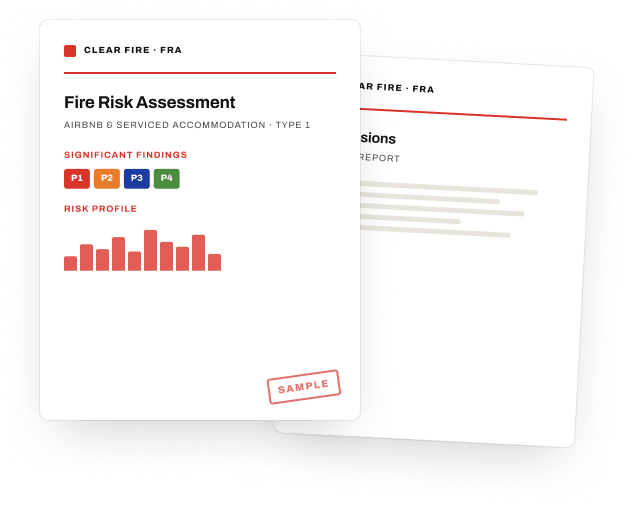
Your assessment arrives as a signed PDF with a management summary, photographic evidence linked to every finding and a separate evidence appendix suitable for property owners, operators and insurers.
Findings are prioritised using the PAS 79-1 risk matrix, helping hosts and operators understand which actions require immediate attention and which can be planned over time.
Easy to work with throughout the process. Everything was explained verbally and in writing, with clear, easy instructions to follow.

Tell us about the property and we'll confirm scope and availability within one working hour. Jon or Kevin on site, signed report within 24 hours of invoice paid.
If you're unsure what applies to your property, speak directly with the assessors who carry out the work. You'll get practical guidance based on the accommodation you operate.
The answer depends on the type of property, how it is operated and the areas under your control. Many short-term accommodation providers have fire safety responsibilities that should be reviewed.
Yes. Occupancy patterns, management arrangements and building layouts can create different fire safety considerations.
Guests should be able to identify escape routes, understand emergency procedures and access relevant fire safety information during their stay.
Yes. Detection arrangements form an important part of the assessment and are reviewed alongside other fire safety measures.
Common findings include inadequate guest information, escape route issues, missing detection coverage and record-keeping gaps.
Yes. Operators managing several properties can instruct assessments across their accommodation portfolio.
Insurers may request documentation relating to fire safety arrangements, risk management and property compliance.
Review frequency depends on changes to the building, occupancy arrangements and previous assessment findings.
Tell us about your site. We'll respond within one working hour during business hours.