Fire risk assessments for
blocks of flats, done properly.

Type 1–4 fire risk assessments for the common parts of purpose-built and converted blocks, written to BS 9792:2025 and the Fire Safety (England) Regulations 2022. Kevin or Jon on-site, never a junior, never a subcontractor.

What we find

A block of flats is the most heavily regulated building you can own.

Since Grenfell, the law for blocks of flats has changed more than for any other building type. The Fire Safety Act 2021 confirmed that the responsible person's duties extend to the structure, external walls and flat entrance doors. The Fire Safety (England) Regulations 2022 added hard duties on door checks, signage and information sharing. The Building Safety Act 2022 created a whole new regime for higher-risk buildings.

A generic common-parts assessment, cloned from the last block and completed in an hour, does not engage with any of this, the evacuation strategy, the external wall system, the compartmentation between flats, or the flat entrance doors that are now explicitly in scope.

Clear Fire assessments are carried out on-site by Kevin or Jon and written to the housing methodology your managing agent, insurer and (where relevant) the Building Safety Regulator will expect to see.

What we find in blocks of flats.

Drawn from Kevin and Jon's combined assessment experience. Common-parts assessments in blocks turn up the same recurring issues, and the costly ones are almost always compartmentation and doors.

Breached compartmentation

Unsealed service penetrations in risers and ceilings, holes left by cabling and pipework. The single most common, and most serious, finding, because it defeats the "stay put" strategy the building relies on.

Flat entrance fire doors

Missing or failed self-closers, gaps out of tolerance, non-FD30S doors, resident-fitted replacements. Now explicitly the responsible person's concern under the Fire Safety Act 2021.

External wall system & balconies

Combustible cladding, render or insulation, and combustible items stored on balconies. Where the wall system is in doubt a PAS 9980 appraisal (EWS) is the recognised route.

Evacuation strategy no longer valid

A "stay put" strategy that compartmentation defects or works on site have quietly undermined, with no interim simultaneous-evacuation plan in place.

Combustibles in common parts

Mobility scooters, bicycles, prams and stored furniture in the protected stair, lobby or escape corridor. A recurring management failing under Article 23.

Communal door & AOV defects

Wedged or non-latching communal fire doors, and smoke control / automatic opening vents that have not been tested or are wired out.

Door-check regime absent

For blocks over 11m: no evidence of the quarterly communal-door and annual flat-entrance-door checks the Fire Safety (England) Regulations 2022 now require.

Information & signage gaps (≥18m)

No secure information box, missing firefighter wayfinding signage, or external-wall and floor-plan information not shared with the fire and rescue service.

Risk-rated findings. Costed action plan. Insurer-ready.

Your assessment arrives as a signed PDF with a one-page management summary at the front, photographic evidence stitched to every finding, and a separately downloadable evidence appendix.

Findings are prioritised against the PAS 79-1 likelihood-and-consequence matrix into four bands, each with an indicative remediation window.

P1

Immediate

Within 14 days · risk to life
P2

Short-term

Within 3 months · serious
P3

Medium-term

Within 12 months · moderate
P4

Improvement

Best-practice · advisory
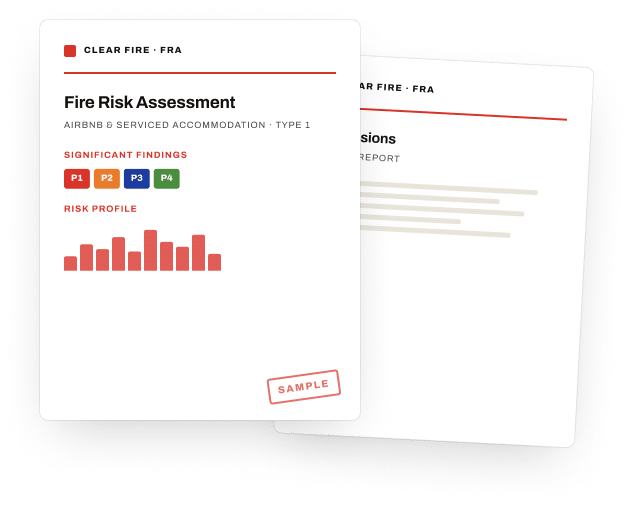
Clear Fire · FRA
Conclusions
Sample Report
Clear Fire · FRA
Fire Risk Assessment
Blocks of Flats · Type 1
Significant findings
P1P2P3P4
Risk profile
SAMPLE

Kevin was superb in responding quickly when asked to step in and replace an inadequate fire risk assessment delivered by another firm.

Charlie Parkes
Verified Google review
★★★★★ · Bonnar FRA
Case Study

How we run multi-site fire compliance as one programme.

For clients with several buildings, we run every site to one report format, one assessor relationship and one annual review cycle, so your responsible person and insurer see a consistent evidence trail across the whole portfolio.

Insurer query or door-check deadline? We can move fast.

Tell us about the block and we'll confirm scope and availability within one working hour. Kevin or Jon on-site, signed report within 24 hours of invoice paid.

Request a same-week visit

Everything you need to know about fire risk assessments for blocks of flats.

Still have questions?

Kevin and Jon are happy to give you a straight answer before you book, no sales pitch, just plain advice.

Speak to an owner →
Yes. The Regulatory Reform (Fire Safety) Order 2005 applies to the common parts of any building containing two or more dwellings, the stairs, lobbies, corridors, plant rooms and the structure around them. The responsible person (usually the freeholder, right-to-manage company or managing agent) must make and maintain a suitable and sufficient assessment of those parts. The interior of each individual flat is not covered by the Order, but the flat entrance door, which separates the flat from the common escape route, is.
For the common parts it is whoever controls them, typically the freeholder, a residents' management company, a right-to-manage company, or the managing agent acting for them. Leaseholders remain responsible for fire safety inside their own demised flat. Where more than one person has control, the Order requires them to co-operate and co-ordinate, which is exactly where assessments often fall down.
The Fire Safety Act 2021 clarified that, for buildings containing two or more sets of domestic premises, the responsible person's duties under the Fire Safety Order expressly include the building's structure and external walls (including cladding, balconies and windows) and the flat entrance doors. It removed the ambiguity that had let some assessments exclude those elements.
In force since 23 January 2023, the Regulations place duties on the responsible person of multi-occupied residential buildings. For buildings over 11 metres: quarterly checks of all communal fire doors and (best-endeavours) annual checks of flat entrance doors. For buildings at least 18 metres or seven storeys: a secure information box, firefighter wayfinding signage, monthly lift and equipment checks, and electronic sharing of external-wall information and floor plans with the local fire and rescue service.
PAS 9980 is the recognised methodology for a fire risk appraisal of an external wall system, used where there is doubt about the cladding or wall build-up. An EWS1 form is the lender-facing record of such an appraisal, often requested for mortgage and valuation purposes. Not every block needs one, our assessment identifies whether your wall system raises questions that warrant a PAS 9980 appraisal, rather than assuming it does.
For housing, the FRA types describe scope and intrusion. Type 1 (the usual baseline) is a non-destructive inspection of the common parts. Type 2 adds destructive inspection of the common parts to check compartmentation. Type 3 includes a sample of the flats (non-destructive); Type 4 adds destructive sampling within flats. Most blocks are well served by a Type 1, with a higher type recommended where compartmentation is in doubt.
Most purpose-built blocks were designed for a "stay put" strategy: each flat is a fire-resisting compartment, so residents not directly affected can remain in place while the fire is contained. That strategy only holds while compartmentation and the flat entrance doors are intact. Where defects, alterations or external-wall concerns undermine it, an interim simultaneous-evacuation strategy (often with a waking watch or common fire alarm) may be needed until they are remediated. Assessing whether your strategy is still valid is a core part of the FRA.
The Building Safety Act's higher-risk-building regime applies to buildings at least 18 metres or seven storeys with at least two residential units, these are registered with, and regulated by, the Building Safety Regulator and carry duties such as the safety case and the "golden thread" of information. Section 156 of the Act also amended the Fire Safety Order for all buildings, tightening record-keeping and responsible-person duties. We tell you clearly which regime your block falls under.
At least annually for most blocks, and immediately after any event that could affect validity, external-wall or compartmentation works, a change of managing agent, a door-replacement programme, or a fire. Higher-risk and sleeping-risk buildings often warrant a shorter cycle.
BS 9792:2025 is the current British Standard methodology for fire risk assessment of housing (it replaced PAS 79-2). Clear Fire common-parts assessments for blocks are written to it by default, and reference the Fire Safety (England) Regulations 2022 and PAS 9980 where the external wall is relevant.

We assess every type of building.

Our fire risk assessment programme covers 11 other property types, each with its own dedicated page, assessor knowledge and report format.

Offices & Commercial Premises

Type 1–2 assessments for single and multi-tenanted offices. Covers means of escape, compartmentation, alarm systems and responsible person obligations.

View service

Warehouses & Light Industrial

Storage classifications, racking risk, sprinkler interaction, shift-work occupancy and insurers' specific requirements for industrial premises.

View service

Managing Agents

Multi-site programmes for portfolio managers. Consistent reporting format, shared document portal and annual review schedules across all properties.

View service

Airbnb & Serviced Accommodation

Short-let and serviced apartment assessments for hosts and operators. Platform compliance, guest safety documentation and local authority requirements.

View service

Commercial Properties

Retail units, mixed-use developments and landlord-controlled commercial space. Tenant obligations, common areas and change-of-use requirements.

View service

Retail

Shop and retail unit assessments covering public-facing occupancy, stock storage risk, emergency lighting and staff training evidence.

View service

HMOs

Houses in multiple occupation. Licensing-compliant assessments covering protected routes, interlinked detection, fire doors and local authority requirements.

View service

Landlords

Private landlord obligations under the Fire Safety Order and the Smoke and Carbon Monoxide Alarm Regulations. Residential and mixed-use portfolios.

View service

Pubs & Restaurants

High public footfall, kitchen fire risk, late-night occupancy and licensing implications. Assessments written for hospitality operators and their insurers.

View service

Small Business

Straightforward, proportionate assessments for small employers. Meets your legal duty without unnecessary complexity or cost.

View service

Care Homes

Vulnerable occupancy risk profiles, protected escape routes, staff procedures and CQC-aligned documentation for registered care providers.

View service
URGENT FIRE SAFETY REQUEST

Insurer deadline this week? Enforcement notice landed?